


Beginner's Guide to Climbing Shoes
Updated: May 5

Buying your first pair of climbing shoes? You've come to the right place. In this post, we'll go over what makes different pairs of climbing shoes unique, and how to pick the right one for you.
The unique shape of climbing shoes
Climbing shoes are shaped in a specific way to concentrate force to a single, small point at the tip of the shoe, making it easier to step on small footholds than with the broad toe box of regular-shaped shoes.
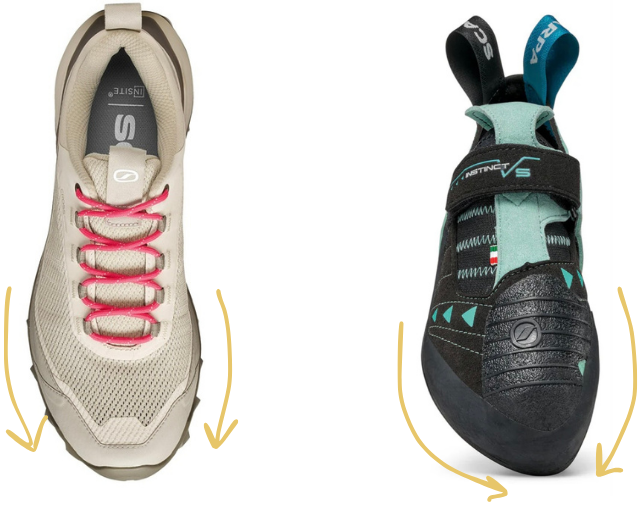
Downturn
Downturn refers to how much the shoe curves down from the heel to the toe.
You might also hear the word “aggressiveness” to refer to downturn; an “aggressive” shoe is a more downturned one.
There is a common misconception that aggressive shoes are “better” or more advanced, while flatter shoes are worse or only for beginners. Though flatter shoes are recommended for beginners because they tend to be more comfortable (and cheaper), the main difference in performance between the types is the climbing styles where they excel, rather than the experience level they’re suitable for.
Climbing shoes are typically divided into three levels of downturn:
Neutral: Little to no downturn
A shoe with a flat sole gives a more even distribution of weight, making it easier to stand on larger, flatter surfaces that are directly under you. They tend to be the most comfortable (and cheapest) shoes, making them suitable for newer climbers.

Aggressive: Very downturned
A shoe with a very downturned sole highly concentrates force into the tip of the shoe, allowing you to better claw into small, precise footholds. They tend to be less comfortable, but perform very well on technical climbing.

Moderate: Some downturn
A shoe with a somewhat downturned sole that offers a middle-ground of the features of neutral and aggressive shoes. They balance comfort and flexibility with precision and pulling ability.

Stiffness
Stiffness refers to how flexible the rubber sole of the shoe is. Shoes can be soft, stiff, or anywhere in between.
Stiff shoes
Stiffer shoes generally have a thicker rubber sole, making them less flexible. They transfer force to the tip of the shoe more effectively, so they tend to be better for pulling in on small footholds. In general, this makes them suited to any angle of climbing, provided that the footholds are edge-like rather than sloped.
They provide more support for your foot, so they tend to be more comfortable for newer climbers. They also tend to last longer, because the sole is thicker, so it takes longer to wear through.
Soft shoes
Softer shoes generally have a thinner rubber sole, making them more flexible. They deform to surfaces more for increased friction, making them better for smearing on large sloped surfaces. In general, this makes them more suited to slab or vertical climbing, where the footholds you're stepping on rely more on friction than on pulling in on a small edge.
They also provide more “sensitivity”: the ability to feel the rock/holds through your shoe. Some climbers like this and feel more secure when they can feel every texture on the foothold, some climbers don't.
They provide less support for your foot, so may be less comfortable for newer climbers. They also wear through faster because of the thinner sole.
You can get a rough idea of how stiff a shoe is by trying to bend it in half. Does it fold easily? Or not at all? Or somewhere in between?

Volume
Volume refers to the amount of space within the shoe, and can be roughly described as the total size of your foot (rather than just the length).
A well-fitting shoe minimizes air pockets and slippage; it should hug your foot well from the toe to the heel.
Climbing shoes typically come in a regular (high- or medium-volume) model and a low-volume (LV) model. These are often also referred to as men’s (high-volume) and women’s (low-volume) models, though the language is moving away from this, as either gender can have a high-volume or low-volume foot.
High-volume (HV)
High-volume shoes are made to fit wider toe boxes, higher midfoots, and thicker heels.
If you find that you still struggle to fit the volume of your foot into shoes that fit you length-wise, you should look for HV shoes.

Low-volume (LV)
Low-volume shoes are made to fit narrower toe boxes, shorter midfoots, and thinner heels.
If you find that you have extra space or air pockets (especially in the heel cup) in shoes that fit you length-wise, you should look for LV shoes.
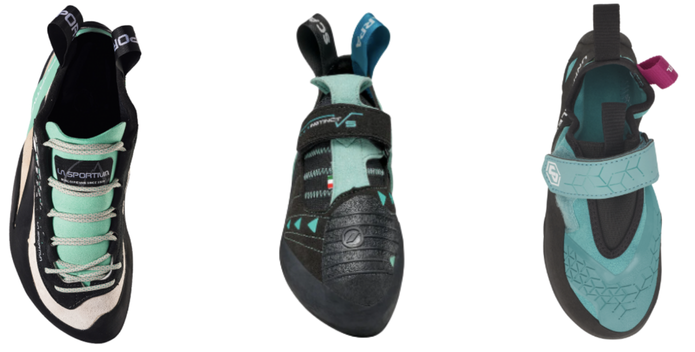
Medium-volume (MV)
Volume is a range, and many people will have moderate-volume feet. In some models, the men’s will be MV rather than HV. Some shoes will have a single middle-ground model rather than both a HV and LV model.

Closure types
Different climbing shoes are fitted with different closure systems. While closure systems are less impactful on the performance of the shoe, they provide different amounts of adjustability for foot size and fit.
Laces
Lace shoes are the most involved for taking on & off, but give the most adjustability for foot width. If you find that any given pair of shoes tends to fit one part of your foot but not another, you may want to wear laced climbing shoes to customize the fit.

Velcro
Velcro is fairly easy and fast to take on and off, while still giving some adjustability for foot width. The more separate velcro closure points your shoe has, the more adjustable the fit is. Most velcro shoes tend to have 1-2 closure points.

Slipper
Slipper shoes are the least involved for taking on and off, as there are no laces or velcro; instead, the shoe is fitted to your foot by the stretchy upper panel of the shoe. This makes them the least adjustable, and the least secured to your foot. If your foot doesn't fit the size and shape of the shoe exactly, your heel may slide out of the shoe while climbing, especially on heel hooks.

Sizing
Finally, the hot topic of climbing shoes: sizing. There is a long-prevailing idea that you should down-size your shoes as much as possible to give you the maximum sensitivity and control of your feet; and if it’s not painful, the shoe is too big. This just isn’t true, and you can risk long-term damage to your feet by squeezing them into too-small shoes over and over. Additionally, if it hurts to put pressure into your feet, it will discourage you from using your feet effectively on the wall... leading to worse climbing technique.
Especially for your first few pairs of shoes, you should prioritize comfort and whatever shoes makes you feel confident in your feet. Your shoe should be snug, but not painful; your toes should reach the end of the shoe and may be slightly bent, but not curled. There should be little wiggle room in the heel of the shoe. This is a big point of difference between brands; many have varying shapes of heel cups, so finding a shoe that fits your specific foot shape is important.
Sizing is also incredibly varied between brands, and even sometimes between models of the same brand. A blanket rule of “X sizes from your street shoe size” should not be followed indiscriminately, but instead as a starting point; you should always try them on and see how they feel on your feet.

The leather in climbing shoes will naturally stretch as you break them in, so it’s okay for them to be a little bit tight out of the box. But you should still be able to wear the shoe without being in pain.
New climbing shoes might take 2-4 weeks (or 4-8 sessions) to break in.
Synthetic (non-leather) climbing shoes tend to stretch less, so they should fit your foot much more closely out of the box than leather shoes.
Choosing the right shoe for you
If you are new to climbing, I always recommend starting with a neutral, stiffer shoe. As discussed earlier, they tend to be the most comfortable, the most durable, and the cheapest, making them great options for anyone just starting out with climbing shoes.
Closure types are mostly up to personal fit and preference. I recommend lace or velcro for most climbers, since slipper shoes rely on your foot fitting the shape of the shoe very well. You are more likely to get a good fit with the adjustability of lace or velcro.
The most important thing for finding the right shoe is trying on different models and sizes of climbing shoes. There really is no other way to know if a shoe is going to fit your foot shape. As discussed earlier, sizing varies so wildly between brands (and sometimes even between models of the same brand) that you definitely want to be able to try on each model individually to know what size you would wear.
Even as you get more experienced, you should ultimately pick the shoe that you feel secure and trust your feet the most in, rather than a shoe that someone else says is the best, or just getting more aggressive shoes.
If this article helped you, you can help me out by sharing it on social media or sending it to someone who might also benefit from it. You can follow me on Instagram @pinkpointclimbing for more content about training for beginner & intermediate climbers!
If you're a beginner or intermediate climber looking to master the fundamental skills of climbing, my PROGRESSION training membership was built for you. Learn how to climb better, not just stronger, with weekly lessons and training sessions designed to bring intention to your climbing. Learn more or sign up at the PROGRESSION membership page.


